Why Cats Need Height: Territory Measured in Three Dimensions
Ask why a cat is sitting on the fridge and the honest answer is that the fridge is the best real estate in the room. Cats do not think about a home as floor area. They think about it as a stack of levels, and most houses are furnished as though only one of those levels exists.
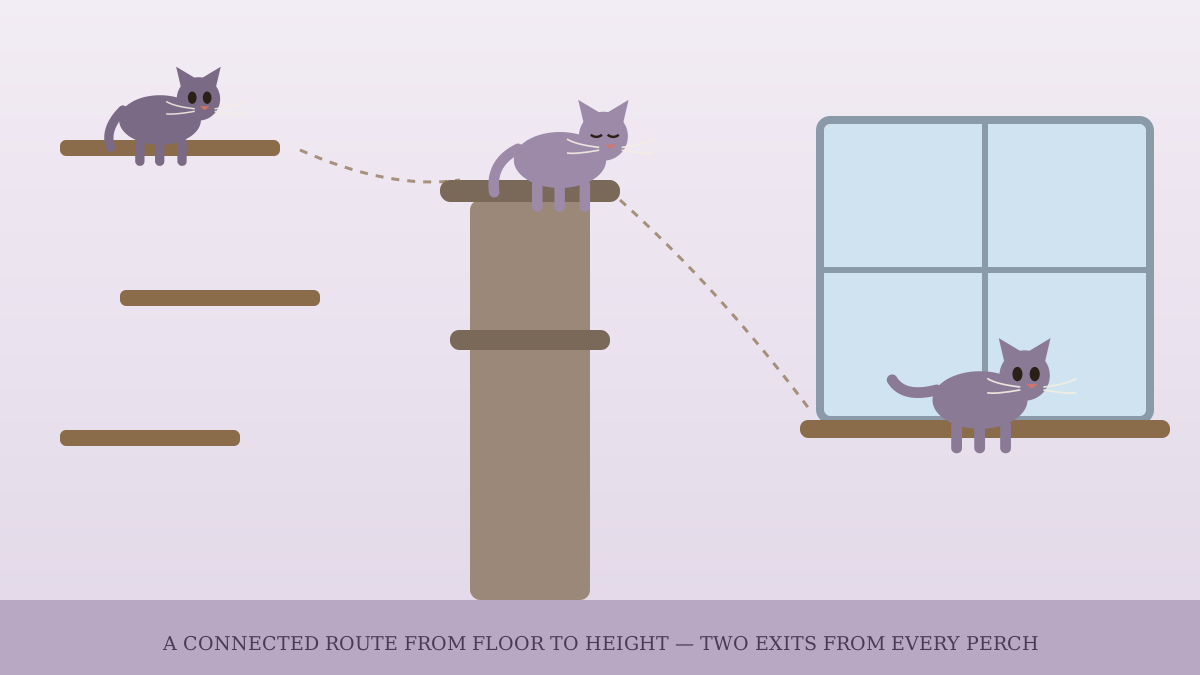
Height is safety and information
An elevated perch offers three things at once: a wide field of view, distance from anything moving at floor level, and a single approach route that is easy to monitor. For an animal that is both a predator and, historically, prey for larger ones, that combination is worth more than comfort. It is why a cat will pick a narrow shelf over a padded bed on the floor.
How cats share space without sharing it
Domestic cats are not obligate social animals. Where several live together, they typically avoid conflict by time-sharing and level-sharing: one takes the sofa in the morning, another takes the top of the bookcase, a third uses the window at dusk. Adding vertical routes and perches genuinely increases the amount of territory available, without adding a square metre of floor.
Signs a home is too flat
- Cats freezing or staring at each other in doorways and corridors.
- One cat routinely blocked from reaching food, water or the litter tray.
- A cat that spends most of its day under the bed rather than on top of something.
- Tension that concentrates at ground-level pinch points — narrow hallways, stair bottoms.
Building upwards, practically
The aim is a connected route, not isolated platforms. A cat should be able to climb from floor to height and travel across without coming down: shelf to cabinet to window sill. Make surfaces non-slip, give every high spot at least two exits so a cat cannot be cornered, and put at least one perch beside a window with something happening outside.
Cat trees work, but so do wall shelves, cleared bookcase tops and a sturdy chest under a windowsill. The requirement is height and escape routes, not a purchase.
Scratching belongs in this conversation
Tall scratching posts serve the same territorial system — they leave visible marks and scent at a height other cats will notice, and they let a cat stretch fully. A post that wobbles or is shorter than the cat's full reach gets ignored, which is why so many owners conclude their cat "doesn't like posts" when the real problem was the post.
Resources: the rule that prevents most household tension
Vertical routes solve movement. What they do not solve is competition for the things a cat needs to reach, and that has its own rule: one of each resource per cat, plus one, distributed rather than grouped.
Three cats therefore need four litter trays, four water sources, four resting places worth having and four feeding stations — and, critically, they need them in different parts of the home. Four trays in a row in one bathroom function as one resource, because a single cat sitting in the doorway controls all of them. The same is true of two bowls side by side.
Distribution matters more than quantity. A water bowl on a windowsill in a bedroom, a tray in a quiet corridor, a bed on a wardrobe, a feeding spot in the kitchen: a cat that is avoiding another cat can still reach everything it needs without a negotiation. Most of what owners describe as bullying disappears when the map changes, without anything about either cat changing at all.
Frequently Asked Questions
Why do cats climb on top of everything?
Height gives a wide view, escape from ground-level traffic and a defensible resting place. In a home, the top of a wardrobe is the equivalent of a good vantage point outdoors.
Does vertical space help with multiple cats?
Considerably. Cats share territory by using different levels and different times rather than by socialising, so adding height effectively adds territory.
How many resources do multi-cat homes need?
A common guideline is one per cat plus one spare for litter trays, water, food and resting spots, spread across separate locations rather than lined up together.
How high does a cat shelf need to be?
Higher than a person's waist is already useful; above head height is better. What matters more than the exact number is that the cat can reach it in stages — a chair, a sideboard, then the shelf — and can get down by a different route.
Do older cats still use vertical space?
Yes, and it remains important to them, but the approach has to change. Arthritis is common and often silent in older cats. Replace jumps with ramps or closely spaced steps, and keep at least one good high resting place reachable without a leap.
Sources & Further Reading
- Ohio State University Veterinary Medical Center — Indoor Pet Initiative — indoorpet.osu.edu
- RSPCA — cat welfare and environment — www.rspca.org.uk
Last updated: 7 August 2026